Wildlife Wednesday – Horned Toad

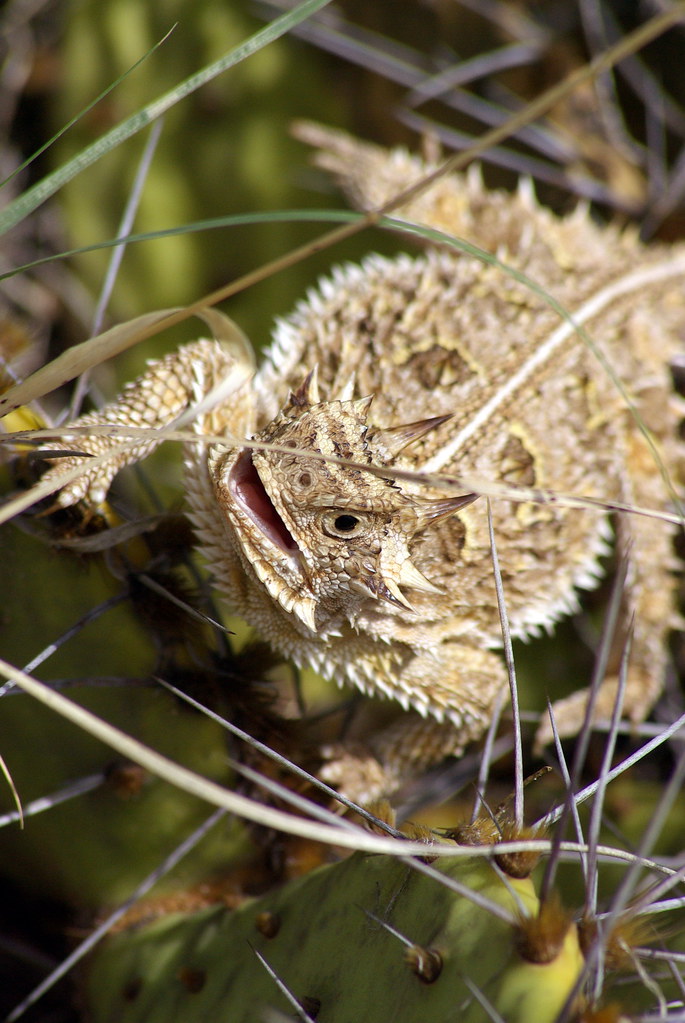
I moved to the Texas Panhandle during summer 2008.  At the top of my list of “things to photograph now that I’m living in the Panhandle” was the horned toad (a.k.a. horny toad, horned lizard, and horned frog).  While growing up my dad saw them on occasion, and he’d come home and tell us about them; however, I had never seen one for myself.  I thought that I’d have to wait awhile to fulfill my “goal.”  Never in a million years would I have bet money on seeing a horned toad during my first trip to Palo Duro Canyon State Park.  But I did — and it was nothing short of awesome — almost like God put this little horned toad on the trail just for me to see!  In the nearly-eight-years that I’ve lived here, I’ve only seen horned toads two other times.

In 1993, the Texas Horned Lizard was declared the state reptile of Texas.  Three types of horned toads call Texas “home;” they vary in length from 3 to 6 inches.  Horned toads are listed as a threatened species in the state of Texas because their population has declined sharply over its historical geographical range.  If you see one, please leave it alone!

Other pictures that I’ve taken at Palo Duro Canyon can be seen on my Flickr page.

Horned Toad

Normandy American Cemetery and Memorial – Part 2

France10

This is a continuation of my previous post about the Normandy American Cemetery & Memorial.  The first post focused on the memorial, and this post focuses on the cemetery.

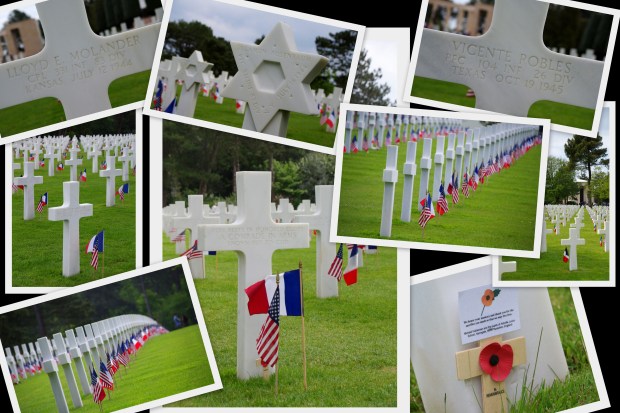
There are a total of 9,387 Americans buried in the Normandy American Cemetery.  Of those, 307 people are unidentified.  The cemetery covers 172 acres.  France gave the United States a perpetual concession to the land occupied by the cemetery (free of charge and taxes), over which the American flag flies.

I felt so many different emotions as we wandered through the cemetery — sadness for the lives lost, anger, awe at the amount of love and appreciation still being poured out by the people visiting the cemetery, and ultimately admiration at the selflessness of all of the Allies who fought during WWII.  It definitely made me proud to see so many American flags flying in a foreign country.

“That road to V-E Day was hard and long, and traveled by weary and valiant men. And history will always record where that road began. It began here, with the first footprints on the beaches of Normandy.” – President George W. Bush


We were lucky enough to visit the cemetery on the day before Memorial Day, so I’m unsure whether or not this large quantity of flower arrangements is there daily or if this was something special because of Memorial Day.

Flower Arrangements


Arthur Porche
Louisiana

In Remembrance

Boyd C. Yount
South Carolina

A Comrade in Arms Known but to God

Continue reading

Weekly Photo Challenge – Life Imitates Art

The Daily Post issues weekly photo challenges.  I’m sure that the challenges are intended for people to use to create new photographs that intentionally meet the requirements of the challenge, which I’m sure would help improve my creativity and photography greatly, but I’m just not sure how to make that work with the constraints of my location.  I want to participate in the weekly photo challenges, though, so I decided that I’d create new photos when I can…and select old photographs for the challenge when I can’t create a new one.

This week’s challenge is “life imitates art.”  When I think of something living imitating artwork, one photograph in particular always comes to mind.  I took this photograph, which I titled Houston Street Meets Abbey Road, when I was in college.  The people in the picture are fellow chemical engineers, and they were all on the same plant design time.  They wanted me photograph them recreating The Beatles’ Abbey Road album cover on the Texas A&M University campus so that they could use the photograph on the cover of their final project design book.  This crosswalk on Houston Street (between Sbisa and Lechner Hall) ended up being the perfect place to recreate the Abbey Road album cover.  This photograph is on my Flickr page and has been viewed 11,158 times (probably because  it has Beatles-esque tags) — I only have three photos with more views than this one.

Houston Street Meets Abbey Road

Flower Friday – Full House Amaryllis

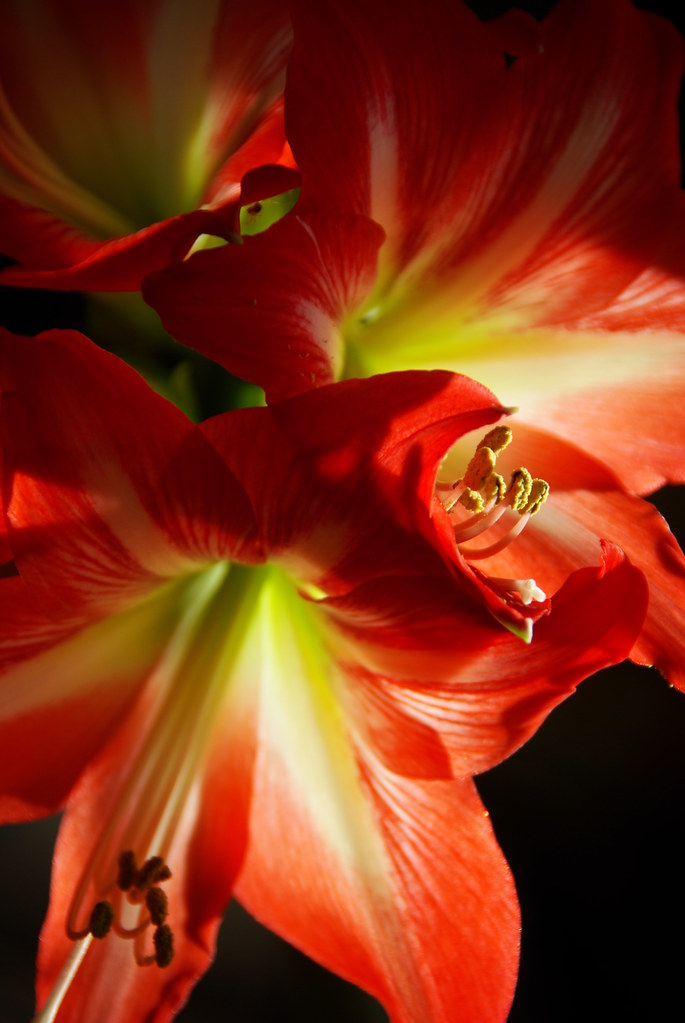
All of this talk about Netflix’s Fuller House series reminded me of the full house amaryllis I bought from American Meadows during December 2010.  It bloomed (a total of eight flowers) during February — this photo was taken almost exactly five years ago (2/15/2011).  I thoroughly enjoyed having a bit of color (and something to photograph) inside during the gloomy winter months.  I need to remember to buy one to have inside next December!  If you want some tips for growing amaryllis indoors, this site has easy-to-follow instructions.

Full House Amaryllis

Normandy American Cemetery and Memorial – Part 1

France9

Our France roadtrip included a couple of days in the Normandy region.  The one place that I HAD to visit while we were in Normandy was the Normandy American Cemetery and Memorial.  I wanted to go there for so many different reasons — to pay my respects, to see in person the cemetery I’d seen so often in pictures, to be able to put the horrific loss of lives into perspective, to see if the people of Normandy remember the sacrifices made for their freedom…

Our first stop when we got to the cemetery was the visitors center.  The visitors center contains many exhibits — we easily could have spent more time looking at all of the exhibits.  My favorite part of the visitors center was the video (you can watch it here), that included stories about 5 or so men who are buried in the Normandy American Cemetery.  One part of the video in particular stuck in my mind — a young bride was adamant that her husband’s body be brought home to the U.S..  Her husband’s brother was being interviewed, and he remembered telling her that she should let him be buried in Normandy because, “he earned that patch of land.”  After the video was over we walked down to Omaha Beach and then walked back up to the cemetery to walk among the graves of our American heroes.

One thing that I learned in Normandy without a doubt is that they still remember the sacrifices…and to me, that makes the loss of life a little easier to swallow.  We saw flowers and small, wooden crosses with paper poppies on them frequently during our time in Normandy.  It really touched me to see so many visual symbols of their appreciation.

I wish that there were some way that all Americans could visit Normandy, but I know that just isn’t possible.  I hope that my photographs help give everyone a better picture of the cemetery and help to remember all of the members of the greatest generation lost during WWII.

I had a really difficult time narrowing down which photographs to include in this post, so I decided that it would be best to split this into two posts.  This one will focus on the memorial and a subsequent post will focus on the cemetery.

General Dwight D. Eisenhower Quote

The French phrase book shown below was also in a photograph of two American soldiers hanging in the hallway on the second floor of Churchill Hotel in Bayeux.  Being the curious bookworm that I am, I wanted to see the inside of one of these books.  I ended up buying one on eBay.  A war-time language phrasebook is quite different from a phrasebook intended for travelers.  In addition to normal phrase book contents, this WWII phrase book also contains sections on reconnaissance, landing a plane, weapons and ammunition, and tools and supplies.

Military-Issued WWII French Phrase Book

General Omar N. Bradley Quote

Flags of the Allies

“In proud remembrance of the achievements of her sons and in humble tribute to their sacrifices this memorial has been erected by the United States of America”

The garden walls, below, (The Walls of the Missing) contain the names of men who are missing in action.  In some instances, there are bronze buttons next to the names.  The buttons indicate the few men whose remains have been found.  The walls contain the names of 1,557 men.

E pluribus unum

Continue reading

The Louvre – Egyptian Antiquities

France8

We spent a small amount of our time at The Louvre looking at the Egyptian antiquities collection.  I suspect that we would have spent more time in that area of the museum had we not spent so much time in the Egyptian antiquities section at the The Metropolitan Museum of Art just five months earlier.  I find objects from Egypt fascinating and wanted to share the a few of my favorite photos from The Louvre’s collection of Egyptian antiquities.


Statue du dieu Horus


Statue du dieu Horus

The Seated Scribe (bel0w) has intrigued museum-goers for years. It was carved from white limestone, and its colors have been fairly well-preserved given the age of the statue.  This video provides interesting commentary on the statue.


The Seated Scribe

2600 – 2350 B.C.


Grand Sphinx

Continue reading

Wildlife Wednesday – Osprey

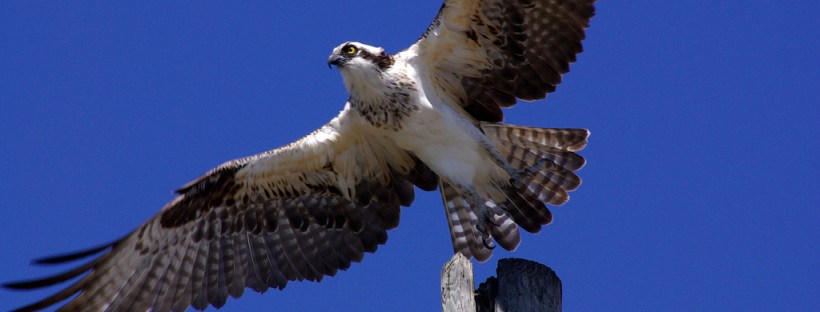
Normally photographs are accompanied with stories about whatever the picture is of; however, my treasured osprey photographs are accompanied with a story about how the picture was taken.

Dad, Mom, and I were bird watching at Indian Point Pier near Portland, Texas during March 2008.  The bird watching there is fantastic, especially if you’re interested in coastal birds.  When I take bird pictures, I always take my first picture the moment I see the bird.  Then I move a few steps closer and take another picture….which eventually results in the bird flying away.  Since Mom and Dad were with me this time, I decided to use them as my assistants.  I got about as close as I thought I could get without making the osprey I was photographing fly away.  Then Mom and Dad strategically walked towards the bird (who was perched high on a powerline-pole…probably keeping an eye out for a fish to eat).  I stood still — focused on the osprey — ready and waiting to get my shot the moment it started to fly.  Our plan worked, and I was able to get a couple of decent shots of the osprey.  Eight years later these are still two of my favorite bird photographs!

Osprey Pre-Flight

Osprey Taking Off

The Louvre Palace

While most posts about The Louvre are probably about the art (like my Mona Lisa post and Sculptures & Statues post), I decided that The Louvre Palace is pretty enough to deserve its very own post.  The Louvre Museum is housed in The Louvre Palace.  The palace is 652,300 square feet and holds nearly 35,000 artifacts.  The museum is the most visited museum in the world.

Construction of The Louvre Palace began in 1202, though it was renovated throughout the years, including the controversial addition if the infamous pyramid (completed in 1989).  How the Louvre was named is unclear, though some think it is a form of “leouar,” a Latin-Saxon word for castle.  The Louvre served as the seat of power in France until Louis XIV moved to Versailles.  It continued to be used as a formal seat of government until 1789, at which point it became a museum.  Following the 1870 renovation, Napoleon Bonaparte III became the first ruler to live in The Louvre since Louis XIV.  You can visit Napoleon’s apartments at The Louvre.

Looking back, I wish I had taken more photographs of the buildings, but it was hard to remember to pay attention to the building when you’re surrounded by so many beautiful works of art.  In addition to the photographs in this post, I also took some nighttime photographs of The Louvre.

We ate lunch on a terrace overlooking the area enclosed by The Louvre Palace.  It definitely offered a neat perspective of the buildings, and I enjoyed getting to see the statues up close.

Continue reading

Monochrome Monday – Brussels, Belgium

In addition to “wildlife Wednesday” posts (my first one featured pronghorns), I’m also planning to make “monochrome Monday” posts which will feature my favorite black and white photographs (thanks to the suggestion of a fellow Redditor).

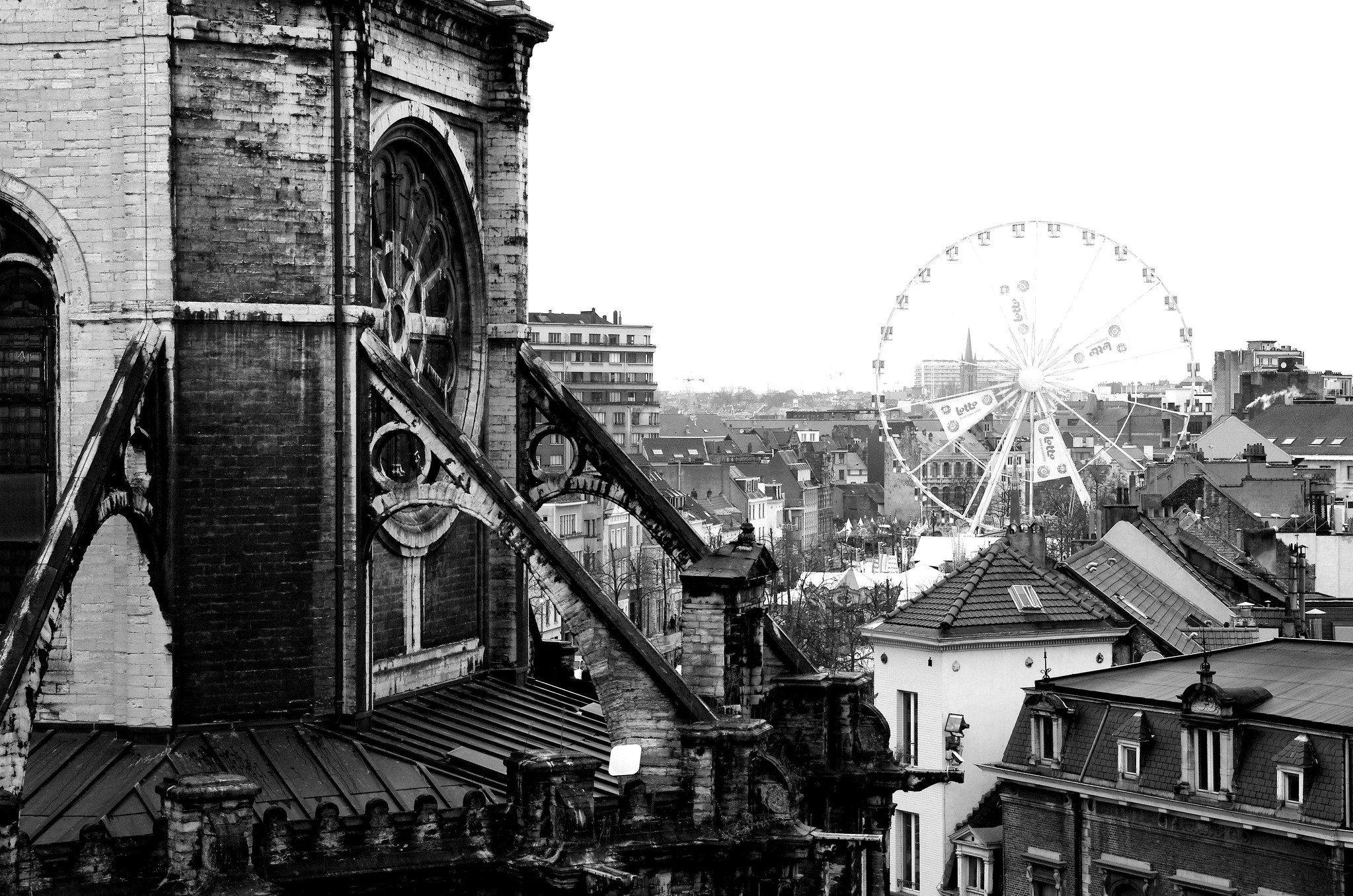
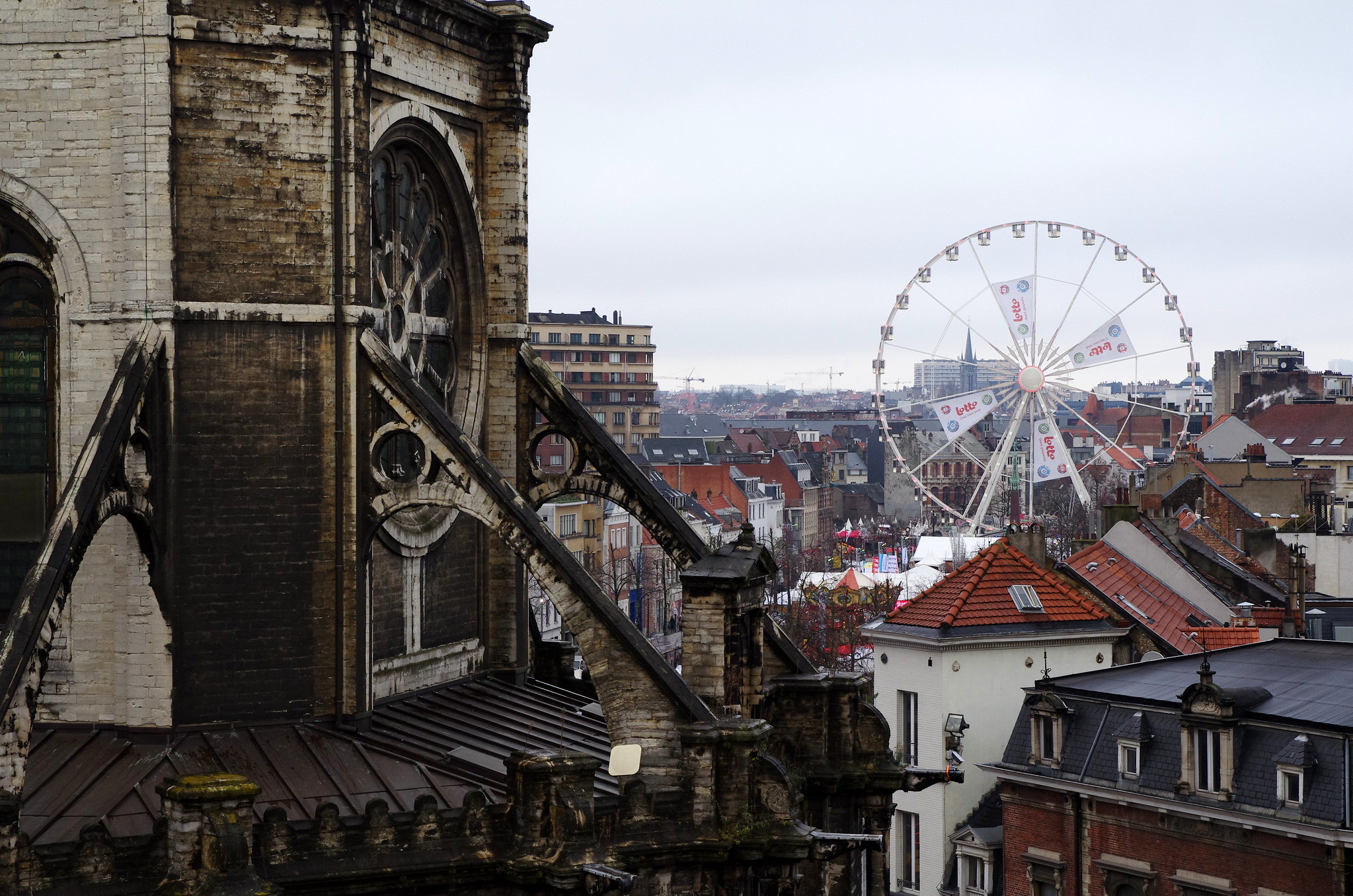
During our first trip to Brussels we stayed at the Novotel Brussels Centre Tour Noire.  The location is decent, and it’s more reasonably priced than other hotels in Brussels — we’d stay there again in a heartbeat.  The hotel was adjacent to the Church of St. Catherine (Sint-Katelijnekerk), and we had a great view of the church from our hotel room window.  The Ferris wheel that is visible in the background was part of the Brussels Christmas Market.  We were able to ride the Ferris wheel a couple of days later.  Though the Brussels Christmas Market can’t compete with German Christmas Markets, we did enjoy ourselves — especially the ice skating, crepes, and Ferris wheel!

In my opinion, this makes a good black and white photograph because there are both black and white objects in the photo, as well as different shades of gray between black and white.  The lack of color gives both the church and the Ferris wheel an eerie feeling that just isn’t there with the colored version of the photograph.

Eglise de Sainte CatherineSint-Katelijnekerk & Ferris Wheel – Brussels, Belgium
black & white

Eglise de Sainte CatherineSint-Katelijnekerk & Ferris Wheel – Brussels, Belgium
color